
Assign mission intent
The operator defines a route, area or target to observe; the aircraft builds a plan onboard instead of receiving continuous stick input.
Platform Autonomy
Turn Drones Into Autonomous Mission Platforms
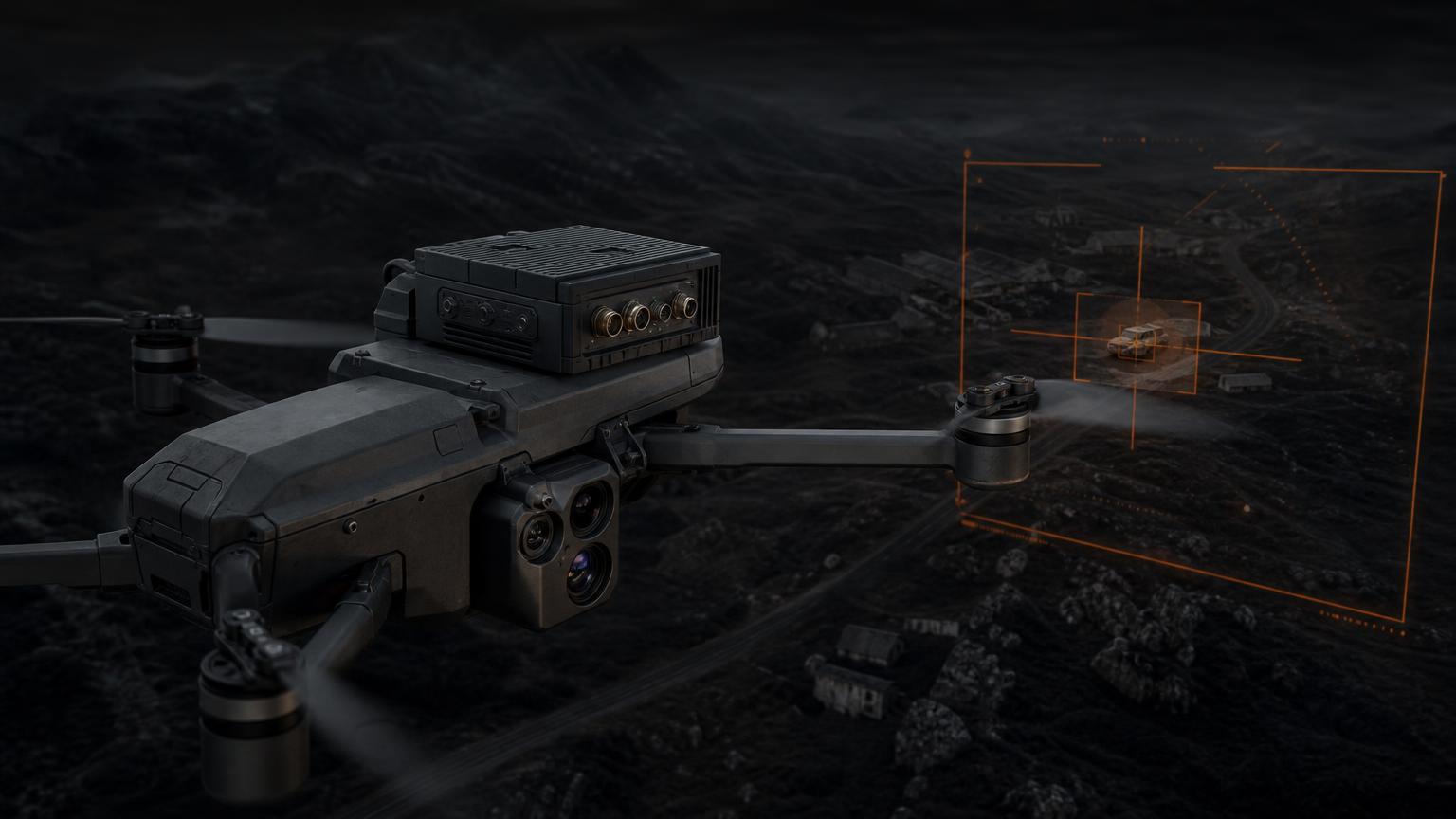
Part of Platform Autonomy — also see Ground Robotics Autonomy Box
Overview
Onboard autonomy for navigation, mission execution, sensor control, target tracking and autonomous mission behaviors.
The Drone Autonomy Suite is onboard software that turns an existing UAS into a mission system: the operator assigns intent and the aircraft plans, navigates, observes and reports on its own. It runs on the same edge computer as Neuronic video analytics, so the drone can navigate without GNSS, keep a sensor on an area of interest and continue the mission when the radio link degrades.
The Drone Autonomy Suite is an onboard autonomy layer that upgrades existing UAS from remotely piloted aircraft into mission systems that execute intent. The operator assigns a mission; the aircraft plans, flies, observes and reports.
Autonomy runs on the drone alongside Neuronic video analytics, so perception and behaviour share the same edge computer: the aircraft can find a target, follow it, keep a gimbal locked on an area of interest and continue the mission when the operator is busy or the link degrades.
The suite integrates with common autopilots and payloads through MAVLink and ROS, and supports cooperative operations where several aircraft, or aircraft and ground robots, work the same mission under NOMAD.
Capabilities
How it works
From sensor input to actionable output in four steps.
The operator defines a route, area or target to observe; the aircraft builds a plan onboard instead of receiving continuous stick input.
The suite navigates, controls the gimbal and manages communications-loss behaviour using the autopilot and payload interfaces over MAVLink and ROS.
When paired with Neuronic video analytics, the drone can find a target, follow it and keep the gimbal locked without tying up a pilot.
Because the mission and perception run at the edge, the aircraft keeps working if the control link drops or bandwidth collapses.
Use cases
Typical situations this system is deployed in, and what it solves in each one.
Indoors, in urban canyons and close to structures the drone navigates from what it sees, so the flight continues without satellite positioning.
The mission is held onboard. If the link is lost the drone keeps to its task or returns safely instead of stopping mid-air.
The drone flies a route or an area on its own, observes from a safe distance, and follows what it finds.
Several drones, or a drone and a ground robot, can share a task — one finds something, the other goes and checks it.
Integration
Built to drop into an existing architecture — standard interfaces, standard hardware, no forced replacement of fielded systems.
Demos
A drone detects a moving ground target, follows it autonomously and keeps the gimbal locked while continuing its mission without continuous operator control.
A low-cost FPV drone fitted with a Raspberry Pi companion computer holds a loiter pattern around a point of interest while streaming video and telemetry.
FAQ
Plain-language answers for integrators, procurement teams and operators.
Tell us the platform, sensor and mission. We will walk you through integration options and arrange a technical demonstration.